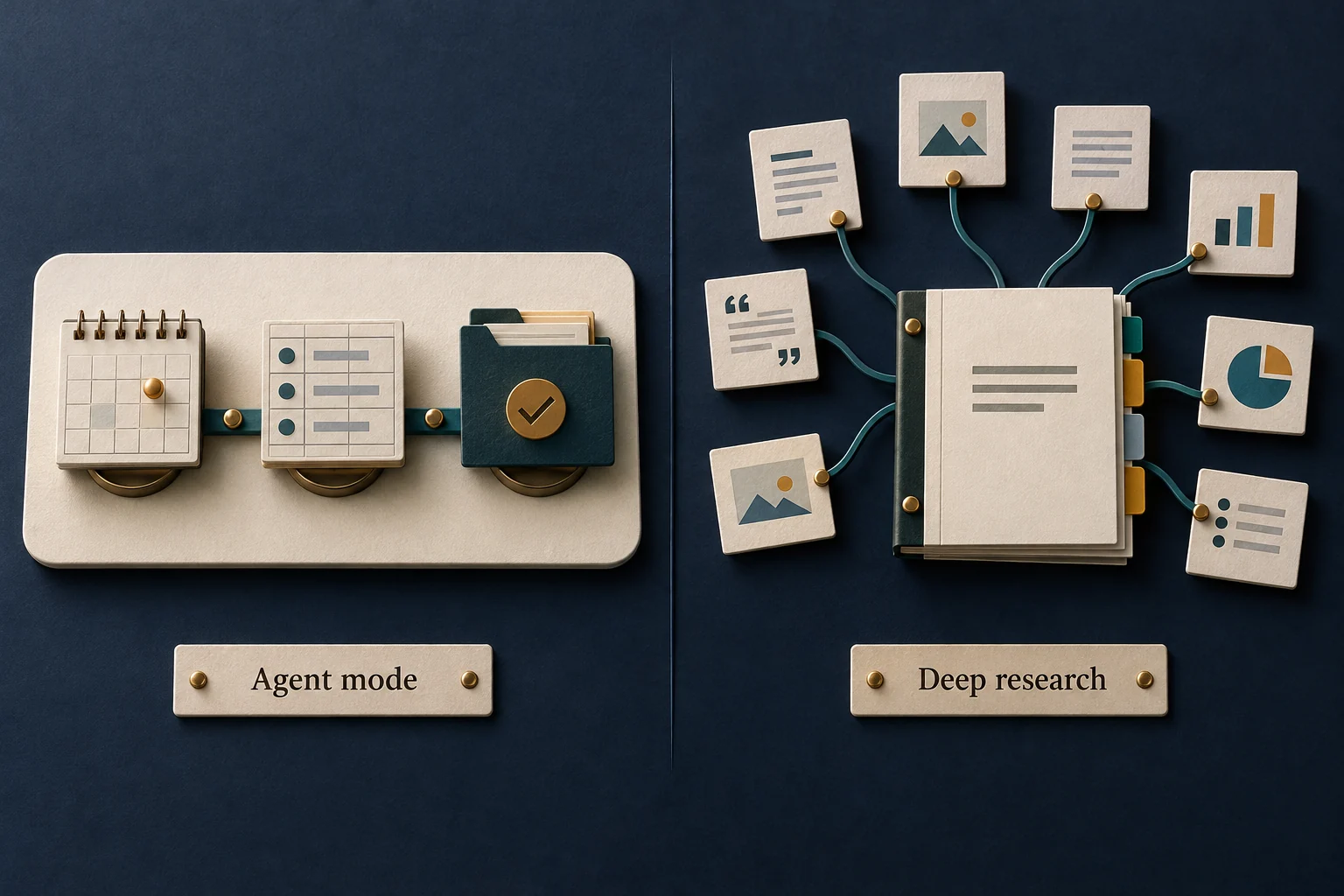
Artificial intelligence has reached a point where an assistant can not only answer questions but also plan, act, and learn from context across multiple steps. ChatGPT now offers two powerful capabilities that reflect this shift. Agent mode and deep research. Both sound similar at first glance, yet they solve different problems. Agent mode focuses on taking action across steps while deep research focuses on delivering high depth analysis with quality and accuracy. Understanding how these two modes work helps teams pick the right approach for customer support, product building, analytics, and strategy.
The big idea behind agent mode
Agent mode turns ChatGPT from a single reply assistant into a doer. Instead of waiting for a prompt and sending back a one off answer, the model plans a sequence of steps, chooses tools when needed, and executes tasks while keeping the bigger goal in mind. You set the objective and boundaries. The agent decides the next best step until it reaches the goal or it needs your input.
What agent mode actually does
- Breaks a goal into steps and sets an order of operations
- Chooses actions such as searching, parsing documents, summarizing, drafting, or running code if tools are available
- Carries context from one step to the next so the work improves as it progresses
- Checks results and decides whether to move forward, retry, or ask a clarifying question
- Produces a final output that ties all steps together
Where agent mode shines
- Customer support workflows that require intake, knowledge lookup, and a clear response
- Sales operations such as lead research, first contact drafts, and follow up scheduling
- Product teams that need quick competitive scans and structured notes
- Data tasks where the agent collects inputs, cleans them, and summarizes trends
- Content teams that want research, outline, draft, and edit in one guided run
Why teams adopt agent mode
Agent mode saves time on glue work. The work that connects tools, people, and steps. It increases reliability because the same playbook runs each time. It improves quality because the agent learns from earlier steps and adjusts later steps without losing context.
The big idea behind deep research
Deep research focuses on depth and rigor. Instead of acting across many tools, it concentrates on reasoning. The model spends more time thinking, cross checking, and organizing information into a structured and defensible answer. It favors completeness and clarity over speed.
What deep research actually does
- Plans a research path and creates a list of questions to answer
- Expands key terms, related ideas, and potential counterpoints
- Organizes findings into sections that map to the objective
- Checks internal consistency and highlights assumptions and limits
- Produces a narrative that explains not just what but why and how
Where deep research shines
- Executive briefs that need context, risks, and next steps
- Product strategies that compare options and explain trade offs
- Policy and compliance summaries that require careful language
- Market analyses that connect trends, numbers, and implications
- Technical write ups that document methods, results, and caveats
Why teams adopt deep research
Deep research increases trust. It reduces guesswork, flags uncertainty, and presents sources or reasoning paths so decision makers can evaluate the strength of the conclusions. It is the right choice when accuracy and clarity matter more than speed.
Agent mode versus deep research
Both modes are smart but they answer different needs. Agent mode is about doing. Deep research is about understanding. If your outcome is an action plan with steps, use agent mode. If your outcome is a well argued answer with evidence, use deep research. Many teams pair them. Start with deep research to frame the problem, then switch to agent mode to execute the plan.
Real world examples
Customer support triage
A retailer wants to reduce first response time. Agent mode can read the ticket, extract key details, look up order status, draft a response, and route complex cases to specialists. Deep research can analyze a month of tickets, cluster common issues, and recommend product or policy changes that would prevent those issues.
Product discovery
A startup wants to explore a new feature. Deep research can map user needs, competing approaches, and technical constraints, then produce a short brief with risks and success metrics. Agent mode can turn that brief into a sequence of tasks, set up interviews, prepare scripts, collect notes, and compile themes.
Revenue operations
A sales team needs better outreach. Deep research can identify ideal customer profiles, industry triggers, and common objections. Agent mode can generate contact lists from public data, create tailored drafts, schedule follow ups, and record outcomes in the pipeline.
Analytics and reporting
A manager needs a weekly pulse. Agent mode connects to a dashboard, pulls the latest numbers, checks thresholds, and writes a note with highlights and next actions. Deep research runs a monthly review that explains why a metric moved, what changed in behavior, and which experiments to run next.
Good practices for agent mode
- Define the goal in one clear sentence and list what success looks like
- Set guardrails such as which tools to use, what data to avoid, and when to pause for approval
- Keep steps small so retries are fast and easy to debug
- Log actions and outcomes so you can audit what happened
- Start narrow with one workflow and expand once it is reliable
Good practices for deep research
- Begin with a scope question and a short list of decision criteria
- Ask for sections such as context, findings, risks, alternatives, and recommendations
- Request definitions of key terms to avoid talking past each other
- Invite the model to list unknowns and data gaps so you can close them
- Keep an executive summary on top so busy readers grasp the point quickly
Risks and how to manage them
- Over automation
Agent mode can overreach if it acts without clarity. Use checkpoints for tasks that have financial or reputational impact and require a human review before final action. - Hidden assumptions
Deep research can sound confident when data is thin. Ask for assumptions, sensitivity checks, and what would change the conclusion. - Data sensitivity
Protect private data with access rules. Restrict tools to the ones your security team approves. Keep secrets out of prompts. Rotate keys and monitor usage. - Change management
New workflows change daily habits. Start with one team, gather feedback, and share quick wins so adoption grows naturally.
How to choose the right mode
Ask three questions. What is the outcome. How much risk is acceptable. How often will this repeat. If the outcome is a repeatable task with clear steps, choose agent mode. If the outcome is a thoughtful answer that informs a decision, choose deep research. If you need both, begin with deep research to set direction, then run agent mode to carry out the plan.
Getting started without overwhelm
Pick one process that is slow, repetitive, and measurable. Map inputs, steps, and outputs on a single page. Run a small trial. Measure time saved, error rate, and user satisfaction before and after. Share the results and expand to the next process. Keep a single owner who maintains prompts, tools, and playbooks so the system stays healthy as your use grows.
Conclusion
Agent mode and deep research represent two complementary ways to work with AI. One turns intentions into actions across steps. The other produces depth and clarity for better decisions. Together they help teams move faster with more confidence. When you match the mode to the job, you cut busywork, reduce errors, and create time for the work that truly moves the business forward.
Want to put agent workflows and deep research to work in your organization
Reach out to TechGenies LLC for guided setup, secure integrations, and delivery playbooks that turn AI into real results