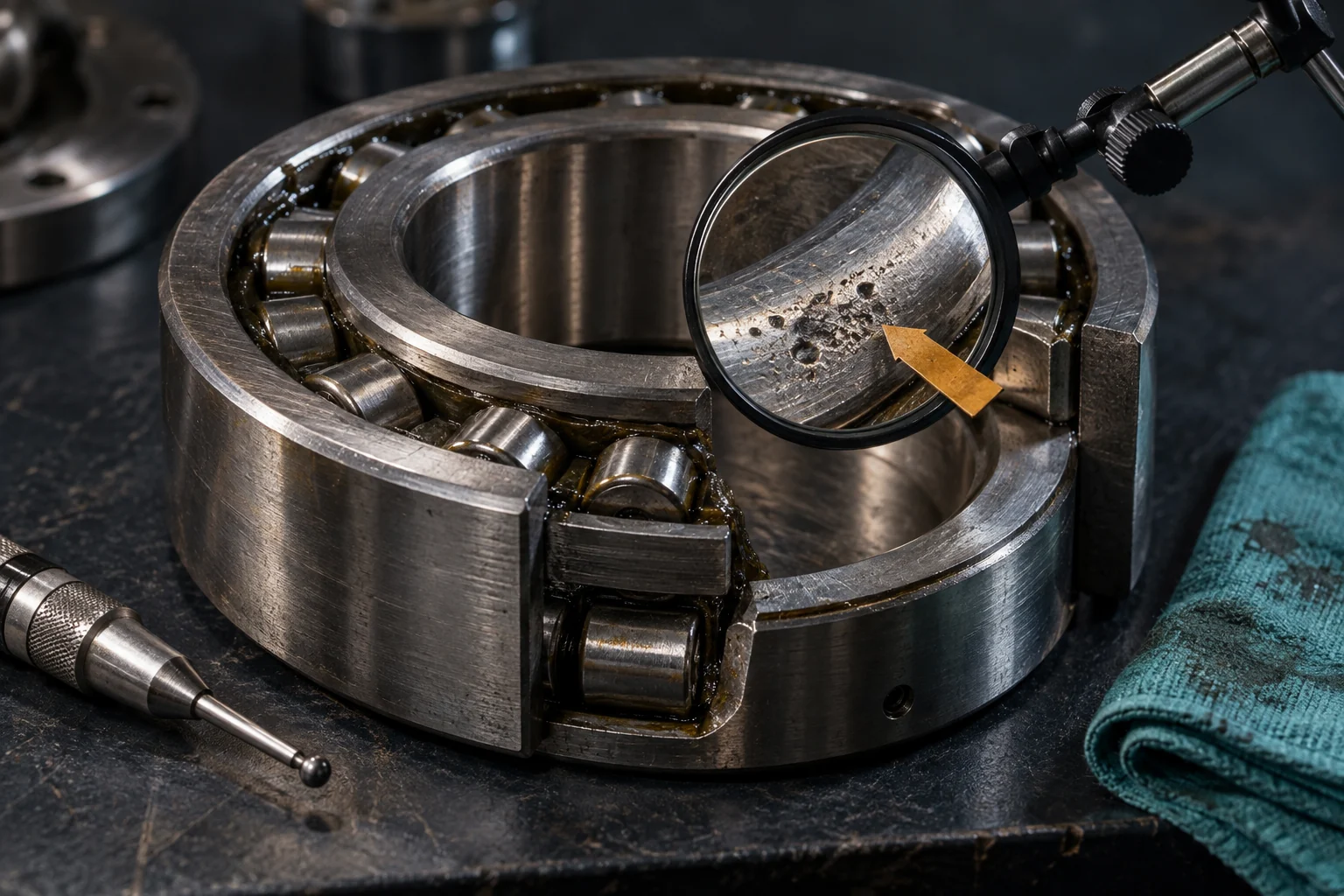
A maintenance team needs more than an alert. It needs enough notice to understand the problem, get the right parts, and choose a safe time to intervene.
That is the practical case for predictive maintenance: use equipment condition to help decide when attention is needed. A fixed service schedule still has a place. The question is where earlier warning would change an expensive decision.
One example from Shell shows why that distinction matters. At a Gulf of Mexico platform, a model flagged a control valve even though conventional monitoring reported 98% compliance. Engineers investigated and found repeated movement that those methods had missed. Shell’s account →
98% compliance.
A valve still needed attention.
A reported equipment-monitoring score did not reveal the whole problem.
5–10%reported valve movement swings
Up to six oscillations in less than a minute, followed by pauses and repetition.
Valve illustration is schematic. The figures describe one reported case.
An unusual reading is a reason to look closer.
A change in vibration, temperature, pressure, or valve position can be useful. It can also reflect a change in operating conditions, maintenance work, or a bad sensor. The model’s job is to help people focus their attention. The engineering decision still needs context.
For a pump or compressor, the starting question should be specific: which failure are we trying to catch, and would an earlier signal give the team time to do something useful? “Predict every failure” is too broad to be a sensible first pilot.
The same discipline applies to the financial case. A percentage from another company is a clue to investigate, not a number to paste into your budget.
Breakdowns fell more than costs.
Reported reductions after introducing predictive maintenance, as summarized in the U.S. Department of Energy’s maintenance guide.
Each highlighted interval shows the published range. The three measures have different denominators and must not be added together.
View the figures and download the data
| Measure | Published range |
|---|---|
| Maintenance costs | 25–30% |
| Downtime | 35–45% |
| Breakdowns | 70–75% |
The intervals are the guide’s stated ranges, not confidence intervals. Results depend on the starting maintenance program and equipment condition. Download the article’s data (CSV).
The savings have to survive the cost of acting.
Fewer failures can still come with more inspections. An alert that arrives after a crew has mobilized may add little value. A model that needs constant tuning can become another maintenance burden.
Before a pilot, agree how the team will count avoided losses, extra investigations, and the cost of running the system. Include the people who own production, maintenance, and the budget. That makes it harder for a promising dashboard to be mistaken for a finished business case.
There is evidence that these systems can operate at substantial scale. In June 2026, C3 AI reported that its program with Shell monitored more than 13,000 pieces of equipment. That is a measure of deployment coverage; it does not tell us how much a particular site saved.
Beyond a handful of machines.
pieces of equipment monitored in Shell’s program with C3 AI
● = 100 pieces of equipment
Lower bound shown; the reported total is higher.
Someone has to own the next step.
A warning has little value if it lands in a dashboard nobody checks. Decide who reviews it, what evidence they need, and how an accepted finding enters the maintenance system. Give the team a way to reject an alert and record why.
Shell’s published workflow puts engineers between an automated alert and maintenance action. That is a useful pattern for a pilot: make responsibility visible before adding more models.
An alert is the beginning of the work.
- 01Check the signal
Review data gaps, operating changes, and known issues.
- 02Investigate
Bring in equipment history and specialist judgment.
- 03Plan the action
Assign the work and agree the right intervention.
- 04Record the result
Close the finding and capture what changed.
Start where the answer could change a decision.
A good first project is narrow enough to evaluate and important enough to matter. Choose an equipment group, a failure mode, and the action an early warning would make possible. Then ask three questions before committing to a rollout.
Can we see the problem?
Check timestamps, sensor history, operating states, and maintenance records. Separate genuine incidents from missing data. If the history is too thin, improve the evidence before training a model.
Can the team respond?
Agree the useful warning time and who owns each finding. Test beside the existing process first. Count missed events and unnecessary investigations as well as successful warnings.
Is it worth continuing?
Compare the pilot with the current method. Include review time, system costs, and the practical value of earlier action. Set a stop or continue decision before results arrive.
These are our recommended pilot checks, not a claim that every asset needs AI. A simpler threshold, a scheduled inspection, or better maintenance records may solve the problem at lower cost.
Predictive models support the maintenance program. They do not replace required inspections, protective systems, or the people responsible for safe operation.
Sources & notes
- Shell, The Shell journey towards global predictive maintenance (2021). Operator account; valve case on pp. 64–65 and workflow on p. 63.
- U.S. Department of Energy / FEMP, O&M Best Practices, Release 3.0 (2010). Chapter 5, p. 5.4. Historical industrial benchmarks.
- C3 AI and Shell expand their reliability program (June 4, 2026). Supplier announcement of monitoring coverage.
Sources checked October 11, 2026. Graphics redrawn by TechGenies from the cited figures. The opening image is an illustration; the valve drawing is schematic. The pilot guidance is our editorial recommendation. Company reports are attributed rather than presented as independently audited results.